England
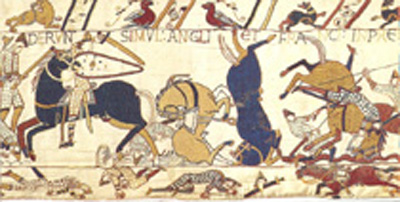
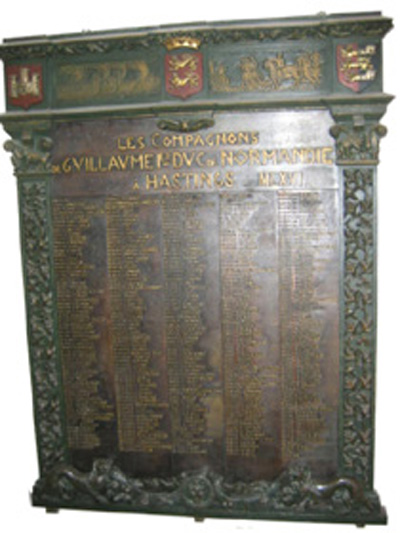
Duke William, conqueror of England in 1066, was accompanied at Hastings by a member of the Saint Clair family, celebrated in the Battle Abbey Roll and church of Dives. Wace remarks in his chronicle:
Normant a pie e a cheual
Les assaillment comme uassal
Donc poinst Hue de Mortemer,
Od lui li sire d’Auuiler,
Cil d’Onebac e de Saint Cler;
Engleis firent mult enuerser.
Which, freely translated, is
The Normans on foot and on horse
Attacked them courageously
Then Hugh of Mortemer spurred his horse,
He had with him the lord of Auvilliers,
And the lords of Les Oubeaux and of Saint Cler;
They overthrew many Englishmen.
By the time of the Domesday survey in 1086, Richard and Bretel, assumed to be his brother, were holding lands in many counties, although of somewhat less extent than might have been expected as members of the baronial class in Normandy. This could have been because their father, supposedly Walderne, had rebelled against duke William in Normandy, so were in no position to expect favours from him as king in England.
Although tradition has it that there was a third brother who settled in Scotland in 1067, there is no documentary evidence that he existed. Recorded in Domesday, however, is Hubert de Saint Clair, who was also holding land in England in 1086. Because he was old enough to do so in his own right at the same time as Richard and Bretel, and because the land he held was never held by their descendants, it strongly suggests that he was their brother. At least one of Hubert’s manors descended to Hamo de Saint Clair, strengthening the case that he was Hamo’s father.
Certainly, from 1120, the Saint Clairs were holding extensive lands in southern England, many of which had been previously held by Eudo de Rie. Eudo had been ‘dapifer’ in England for William I, William II (Rufus) and Henry I, and had been rewarded with many holdings. When he died in 1120, the lands ‘escheated’ to Henry, who granted them to his friends and followers. If the Saint Clairs had been undertenants on some of Eudo’s lands, it is more than likely that those tenancies were regranted by Henry I to hold directly of him.